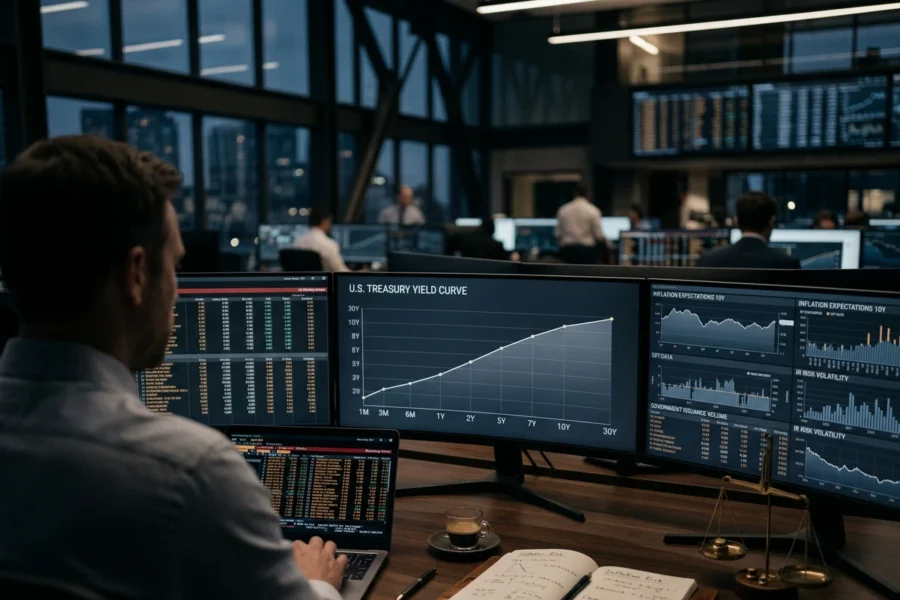
Why the stock market goes up and down ultimately comes down to changing expectations. Investors continually reassess future profits, economic conditions, interest rates, and the price they are willing to pay for company ownership.
According to Investor.gov, a share of stock represents an ownership position in a company. The price of that ownership changes as investors process new information, revise their expectations, and decide what they are willing to pay.
Stock prices can be influenced by:
- Company profits
- Interest rates
- Inflation
- Consumer demand
- Economic growth
- Political decisions
- Industry conditions
- Business leadership
- Competition
- Investor confidence
The stock market therefore responds not only to what is happening today, but also to what investors believe may happen next.
Supply and Demand Move Stock Prices
The immediate explanation for why the stock market goes up and down is supply and demand.
Every trade requires a buyer and a seller, but those participants may disagree about the right price.
A buyer might be willing to pay $50 for a share, while the seller wants $52. If buying interest strengthens, someone may eventually accept the higher price. If sellers become more eager to leave, they may lower the amount they are willing to accept.
Across millions of transactions, these changing decisions create the prices displayed throughout the trading day.
Market and limit orders continually interact as buyers and sellers specify when and at what price they are prepared to trade. A market order prioritizes immediate execution, while a limit order sets a maximum purchase price or minimum selling price.
When demand increases relative to the number of shares available for sale, prices tend to rise. When more investors want to sell than buy at the current level, the price may fall until buyers return.
Stock Prices Reflect Expectations
Markets are forward-looking.
Investors do not value a company solely by examining what it earned last year. They also form opinions about what it might earn next year and many years into the future.
This is why a company can report impressive results and still see its share price fall.
Suppose investors expected a company to earn $3 per share, but it reports $2.70. The business may remain profitable, yet the result could still disappoint because expectations were higher.
The reverse can happen when a struggling company reports results that are less weak than expected.
The market is constantly comparing:
What happened against what investors had already expected to happen.
If highly optimistic expectations are already reflected in the share price, respectable results may not be enough to support it.
This gap between reality and expectation is another central reason why the stock market goes up and down.
Company Earnings Matter
A stock represents ownership in a business, so the financial health of that business matters.
Investors may examine:
- Revenue
- Net income
- Earnings per share
- Profit margins
- Cash flow
- Debt
- Customer growth
- Operating costs
- Market share
- Management forecasts
FINRA explains that earnings per share measures a company’s profitability relative to the number of outstanding common shares. It is a widely used financial metric, although it should not be considered in isolation.
A company producing reliable profit growth may become more valuable. However, investors must also decide how much they are prepared to pay for those profits.
A fast-growing business can fall sharply when its rate of growth begins to slow. A mature company may rise after improving efficiency, reducing debt, or returning more cash to shareholders.
Earnings surprises can move prices quickly
Imagine analysts expect a company to earn $2 per share, but it reports $2.30.
That positive surprise may encourage investors to raise their estimates of the company’s future value.
If the company earns $2.30 when investors expected $2.60, the same figure may trigger selling.
The reported number matters, but so does the expectation against which it is measured.
Interest Rates Affect Stock Valuations
Interest rates are another major part of understanding why the stock market goes up and down.
Rates influence borrowing costs and spending decisions throughout the economy.
When interest rates rise:
- Loans become more expensive
- Companies may delay expansion
- Consumers may reduce spending
- Debt repayments can consume more corporate cash
- Savings accounts and bonds may become more attractive
- Future company profits may be assigned a lower present value
When rates fall, some of those pressures may ease.
The Federal Reserve explains why interest rates matter because changes in rates affect borrowing, household spending, business investment, employment, and broader economic activity.
This does not mean stocks always fall after a rate increase or rise after a rate cut.
Markets often anticipate policy changes before they happen. Investors also consider the reason behind the decision.
Higher rates introduced during strong economic growth may be interpreted differently from higher rates imposed while businesses and households are already under pressure.
Inflation Changes Costs and Expectations
Inflation describes a broad rise in the prices of goods and services.
For companies, inflation may increase the cost of:
- Materials
- Energy
- Transportation
- Wages
- Rent
- Insurance
- Borrowing
Some companies can protect their profit margins by raising prices. Others may lose customers if they attempt to pass every increase on.
Investors also watch inflation because it can influence future interest-rate decisions.
If inflation remains higher than expected, markets may begin anticipating tighter monetary policy. Stock prices can therefore react before the Federal Reserve formally changes rates.
The Federal Reserve monitors several measures of inflation because different price indexes cover different goods, services, and areas of consumer spending.
Inflation does not affect every business equally. A development that harms one industry may benefit another.
Economic Growth Shapes Confidence
The stock market and the economy are connected, but they are not the same thing.
Investors monitor indicators including:
- Employment
- Consumer spending
- Business investment
- Manufacturing
- Housing activity
- Economic output
- Consumer confidence
Strong economic activity can support company revenue and profits. A slowdown can weaken demand and make investors more cautious.
However, the market often moves before the economic data appears clearly positive or negative.
Investors may begin buying while conditions still look weak because they expect a recovery. They may start selling during a healthy period because they believe growth has reached its peak.
This helps explain why the market can rise during discouraging economic news or fall while current figures still appear strong.
Stock prices reflect expectations about the future rather than providing a perfect description of conditions today.
News Can Change Expectations Quickly
Any event capable of affecting company profits, interest rates, risk, or confidence can move stock prices.
Examples include:
- Elections
- Government policy changes
- Wars and international tension
- Trade restrictions
- Energy-price shocks
- Regulatory decisions
- Natural disasters
- Technological breakthroughs
- Corporate scandals
- Public-health emergencies
The market’s reaction often depends on whether the event was expected.
A widely anticipated announcement may produce little movement because investors have already adjusted their positions. A genuine surprise can cause a much faster repricing.
The important issue is not simply whether the news appears good or bad. It is whether the development changes what investors previously believed.
Investor Sentiment Can Magnify Moves
Investor behavior is an important part of why the stock market goes up and down.
Markets contain professional institutions, individual investors, computer models, market makers, traders, and automated systems. They are not perfectly calm calculators.
Fear and optimism can amplify price movements.
When prices rise steadily, investors may become more confident and willing to pay higher valuations. Their buying can attract further attention and create additional demand.
When prices fall, worried investors may sell to prevent larger losses. That selling can place further pressure on prices and encourage others to leave.
This can create a feedback loop:
- Rising prices encourage optimism
- Optimism attracts more buyers
- Additional demand pushes prices higher
The same process can work in reverse during a decline.
FINRA describes panic selling as investors rapidly disposing of shares because they fear further declines, sometimes without fully considering whether selling is sensible. Widespread selling may then contribute to the decline investors feared.
Market behavior is also shaped by fear, confidence, and the way people interpret financial risk, themes explored further in The Psychology of Wealth: Why Your Thinking Is Keeping You Poor.
Why the Whole Market Can Move Together
Individual stocks move because of developments affecting specific businesses.
The broader market moves when investors reconsider conditions affecting many companies at once.
A change in interest rates, inflation, taxes, regulation, or economic growth can alter the outlook for hundreds of businesses simultaneously.
Major indexes can also be heavily influenced by their largest companies.
An index may rise even when many smaller stocks fall if a small number of highly valued companies produce large gains.
This is why a headline saying “the market rose” does not mean every stock performed well.
The stock market is not one company or one price. It is a collection of businesses, sectors, industries, and investor decisions summarized through indexes.
Why Some Stocks Move More Than Others
Not every stock reacts equally to the same information.
The size of a price movement may depend on:
- Company size
- Trading volume
- Debt levels
- Profitability
- Industry exposure
- Growth expectations
- Dependence on borrowing
- Number of available shares
- Exposure to commodities
- Geographic reach
A small company with relatively few shares changing hands can move sharply after a modest order enters the market.
A large and heavily traded company may require considerably more buying or selling pressure to produce the same percentage change.
Growth companies can be especially sensitive to changing expectations because much of their valuation may depend on profits that investors expect far into the future.
Market Volatility Is Normal
Volatility describes the size and frequency of market movements.
Some trading sessions are quiet. Others produce sharp swings as investors absorb new information and change their expectations.
Price movement is a normal feature of a functioning market. When economic conditions, business results, or risk perceptions change, prices need to adjust.
During severe declines, US exchanges use market-wide circuit breakers explained by the Securities and Exchange Commission to pause trading temporarily when specified market-decline thresholds are reached.
These safeguards do not prevent investment losses. Their purpose is to pause activity during extreme conditions and support more orderly trading.
Volatility can be uncomfortable, but the absence of movement would not necessarily mean the absence of risk.
Why Markets Can Rise Over Long Periods
Although markets regularly decline, broad stock indexes can benefit from the growth of productive businesses over long periods.
Companies may:
- Develop new products
- Improve technology
- Increase productivity
- Enter new markets
- Raise prices
- Reinvest profits
- Acquire competitors
- Return cash to shareholders
Struggling businesses may shrink or leave an index, while stronger companies can grow and take their place.
This does not mean markets rise smoothly or that future gains are guaranteed.
Individual companies can fail. Entire markets can experience long periods of poor performance. Investors may also suffer permanent losses when they pay too much, sell under pressure, or own companies whose financial condition deteriorates.
Price and Value Are Not the Same
Price is the amount at which a stock currently trades.
Value is an estimate of what the underlying ownership may reasonably be worth.
Those two figures are not always equal.
During periods of intense optimism, investors may pay prices based on unusually strong expectations. During periods of fear, prices may fall below what some investors believe the businesses are worth.
The difficulty is that value cannot be observed with certainty.
It depends on assumptions about:
- Future profits
- Interest rates
- Competition
- Business risk
- Economic conditions
- Management performance
- Events that have not yet happened
Two informed investors can examine the same company and reach very different conclusions.
That disagreement is what creates a market. One participant believes the current price offers an opportunity; another believes it is time to sell.
What Daily Market Moves Do Not Tell You
A rising market does not prove that every stock is fairly valued.
A falling market does not mean every business is failing.
One day of trading also says very little about the long-term quality of a company.
Short-term prices may be influenced by:
- Breaking news
- Fund withdrawals
- Forced selling
- Options activity
- Computerized trading
- Market positioning
- Changes in sentiment
Longer-term results are more closely connected to business performance, future earnings, financial strength, and the price originally paid.
This is why attempts to explain every daily market movement with one neat headline can be misleading. Several forces are usually operating at the same time.
How This Connects to Building Wealth
Understanding why the stock market goes up and down helps distinguish business ownership from short-term speculation.
Stocks are financial assets representing ownership interests in companies. Their prices fluctuate because future profits cannot be known with certainty and investors continually revise what they are prepared to pay.
That volatility is one of the risks attached to the asset.
As explained in What Is an Asset? A Practical Wealth Guide, something can hold genuine economic value without being safe, guaranteed to appreciate, or immediately liquid at a favorable price.
This also connects to How Wealth Is Built Over Time. Long-term wealth depends less on predicting every short-term movement and more on understanding ownership, risk, valuation, resilience, and the role an asset plays within a wider financial position.
Building wealth does not require pretending uncertainty can be removed. It requires recognizing uncertainty and making considered decisions around it.
What Really Moves the Stock Market
The clearest explanation of why the stock market goes up and down is that prices respond to changing expectations and changing demand.
Company earnings affect what businesses may be worth. Interest rates influence borrowing costs and valuations. Inflation changes operating costs and policy expectations. Economic and political events reshape confidence. Investor behavior can then magnify the reaction.
No single factor controls the market every day.
Stock prices emerge from countless participants continuously reassessing the future—and agreeing to trade only when they meet at a price.
This article is for general educational purposes and does not constitute financial, investment, tax, or legal advice.