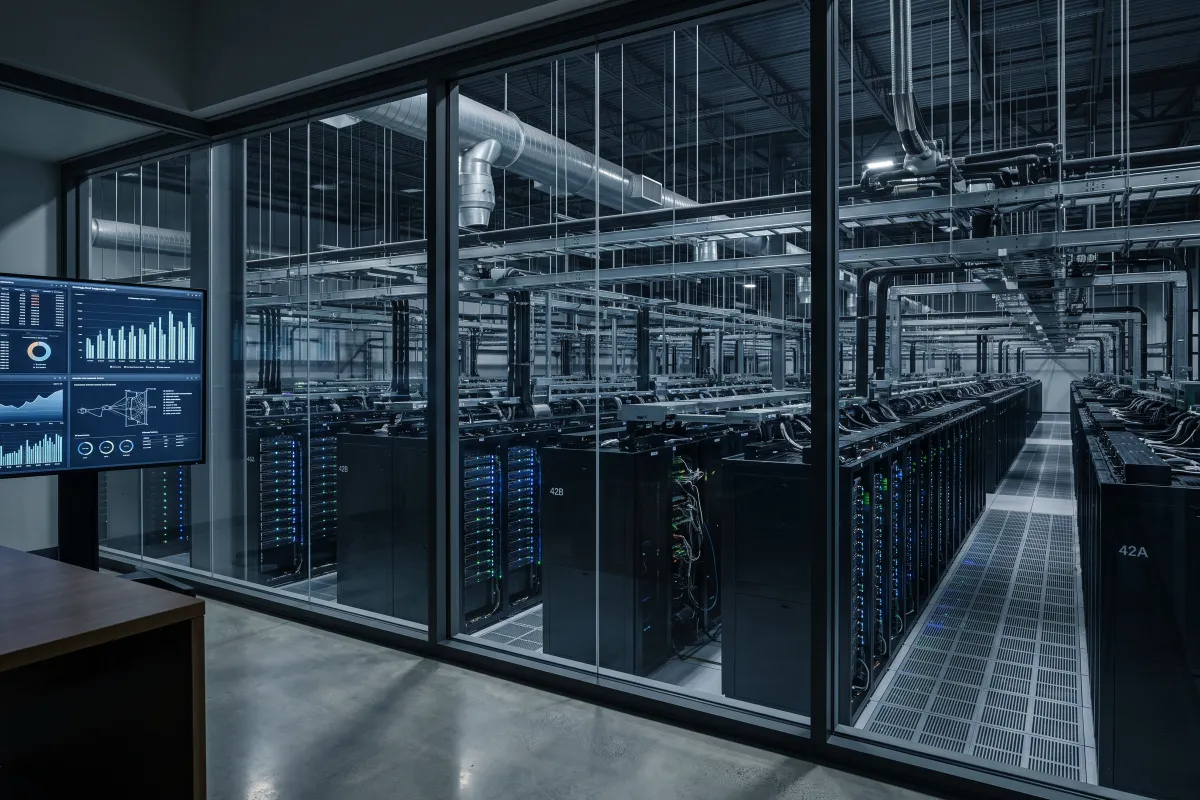
A neocloud is a newer type of cloud infrastructure provider built around the intensive computing requirements of artificial intelligence and high-performance computing. Rather than trying to offer every cloud service, neoclouds typically concentrate on access to powerful GPUs, high-speed networking and specialized infrastructure for training and running AI models. Their rapid growth shows how the AI boom is creating a new, highly capital-intensive layer of the technology industry.
The rise of generative AI has changed the economics of computing. Training and operating advanced models can require enormous clusters of specialized processors, vast amounts of electricity and data centers designed around unusually dense computing workloads. That has created room for specialist providers alongside the established cloud giants.
For investors, the important story is not simply that another type of cloud company has appeared. Neoclouds illustrate how software demand can translate into physical infrastructure, long-term contracts, billions of dollars of financing and substantial business risk.
What Is a Neocloud and How Does It Work?
What is a neocloud? The term generally describes a specialist cloud provider focused on modern AI and high-performance computing workloads. These companies assemble large pools of graphics processing units, or GPUs, and make that computing capacity available to AI developers, research organizations and businesses.
Traditional cloud computing was built around flexibility. Customers could rent storage, databases, virtual servers, networking and hundreds of other services rather than owning their own infrastructure. Neoclouds retain the rental model but specialize much more heavily in the computing resources demanded by AI.
A customer developing an AI model might need thousands of advanced GPUs connected by extremely fast networks. Buying the hardware outright can require huge upfront investment, while obtaining enough capacity from a conventional cloud platform may be expensive or constrained by availability. A neocloud attempts to solve that problem by building infrastructure specifically for these workloads and selling access to it.
Why Neoclouds Have Emerged
The basic idea behind specialist computing providers is not entirely new. What has changed is the scale of demand.
Modern AI models require extraordinary amounts of computing power. The hardware is expensive, the electricity requirements are substantial and the supporting infrastructure must be capable of moving enormous quantities of data between processors with very low latency.
At the same time, advanced GPUs have periodically been difficult to obtain in sufficient quantities. Companies able to secure processors, power, data-center capacity and financing have therefore been able to sell something increasingly valuable: access to AI compute.
That has helped companies such as CoreWeave, Crusoe and Nscale grow rapidly. Reuters reported in September 2026 that Crusoe had raised more than $3 billion in a funding round valuing it at roughly $30 billion, citing Bloomberg News, and described the company as one of the emerging neocloud providers serving AI applications. Nscale, meanwhile, is seeking approximately $3.5 billion of pre-IPO financing after signing major AI-compute commitments.
Neocloud vs. Traditional Cloud Computing
| Feature | Neocloud | Traditional Hyperscale Cloud |
|---|---|---|
| Primary focus | AI and high-performance computing | Broad range of cloud services |
| Core infrastructure | Large GPU clusters and specialized networking | General compute, storage, databases, software and AI services |
| Typical customers | AI labs, developers and compute-intensive enterprises | Businesses of almost every type |
| Business advantage | Specialization and access to AI compute | Scale, ecosystem and breadth of services |
| Capital requirements | Extremely high relative to business maturity | Extremely high but supported by large established businesses |
The distinction should not be exaggerated. Major cloud platforms also offer advanced GPUs and extensive AI infrastructure. Neoclouds are not replacing hyperscalers. Instead, they are adding specialist capacity to a market where demand for computing resources has expanded rapidly.
Why GPUs Matter to the Neocloud Model
GPUs sit at the center of the neocloud business model because they are particularly effective at performing many calculations simultaneously. That makes them well suited to the mathematical operations used in machine learning.
But owning GPUs is only part of the challenge.
Thousands of processors need to communicate efficiently. That requires high-speed networking, sophisticated cooling, reliable power and software capable of allocating computing resources across customers. A powerful chip sitting in an unsuitable data center cannot deliver the same economic value as part of a properly designed cluster.
This is why the AI infrastructure boom extends far beyond semiconductor companies. Data-center developers, power providers, networking companies, cooling specialists and lenders can all become part of the economic chain.
How Neoclouds Make Money
At the simplest level, neoclouds purchase or finance expensive computing infrastructure and sell customers access to it.
Some capacity can be sold on demand, allowing customers to pay for computing resources as they use them. More importantly for large infrastructure projects, providers can sign multi-year agreements under which customers commit to substantial amounts of capacity.
Those contracts can make enormous construction programs easier to finance because lenders and investors can see future contracted revenue supporting the infrastructure.
CoreWeave’s public filings provide a useful illustration. The company says it serves enterprises, AI labs and technology companies through multi-year committed contracts as well as on-demand access. At the end of 2025, its committed contracts had a weighted-average duration of roughly five years.
The model begins to resemble infrastructure finance as much as conventional software. Capital is raised, physical capacity is constructed, long-term customers are secured and the resulting cash flows help support the financing.
Why Building a Neocloud Requires So Much Capital
Software businesses are often attractive because a successful product can be distributed to additional customers at relatively low incremental cost. Neocloud economics are different.
Every major expansion requires physical resources: processors, networking equipment, land, buildings, cooling systems and access to large quantities of electricity.
That creates an enormous funding requirement.
CoreWeave reported $13.6 billion outstanding under delayed-draw term-loan facilities at June 30, 2026. The filing also shows that its capital investments include servers and networking equipment used to develop and deploy AI models. In August, CoreWeave entered into another $2.6 billion delayed-draw term-loan facility, primarily to finance capital expenditures for customer contracts, including GPU servers and related infrastructure.
Nscale’s current effort to raise approximately $3.5 billion before a potential IPO reinforces the same point. AI infrastructure can generate huge contracted revenue figures, but fulfilling those contracts can require equally extraordinary capital commitments.
That makes financing capability a competitive advantage. A provider that can obtain capital more cheaply may be able to build capacity faster and offer more attractive economics to customers.
Why Long-Term AI Contracts Matter
A multi-billion-dollar AI infrastructure contract can look extraordinary, but the headline number does not represent money arriving immediately.
Contracts may run for years, while the provider must first finance and construct the infrastructure needed to deliver the promised capacity. Revenue therefore depends on successful execution.
This distinction matters when evaluating fast-growing infrastructure companies. Contracted demand can improve visibility, but it does not remove construction risk, financing risk or customer risk.
In September 2026, Reuters reported, citing The Information, that Nscale had told prospective investors it had around $103 billion of contracted revenue. The scale demonstrates the appetite for AI computing, but it also illustrates how rapidly the financial commitments surrounding the sector have grown.
The Customer Concentration Risk
One of the biggest risks in the neocloud model is customer concentration.
The companies buying the largest quantities of AI compute are themselves concentrated among a relatively small number of well-funded technology businesses and AI laboratories. A provider may therefore build enormous infrastructure around contracts with only a handful of customers.
CoreWeave explicitly identifies this as a risk in its regulatory filings, noting that a substantial portion of revenue comes from a limited number of customers and that losing or seeing materially lower spending from a major customer could damage its business.
This connects directly with WealthyVue’s guide to what concentration risk means for investors. Concentration does not only occur inside investment portfolios. Businesses themselves can become heavily dependent on individual customers, suppliers, products or sources of financing.
Neoclouds and the AI Infrastructure Boom
The rise of neoclouds reveals something important about artificial intelligence: AI is not purely a software story.
Behind every model is a physical chain of processors, networking equipment, power generation, transmission infrastructure, cooling systems and data centers. The larger AI workloads become, the more capital that physical layer can absorb.
This is one reason the current AI cycle differs from many earlier software booms. Companies are not simply hiring developers and distributing applications over existing infrastructure. They are committing billions of dollars to create entirely new computing capacity.
For WealthyVue readers, this is where technology intersects with capital allocation. The economic question is not merely whether AI usage grows. It is whether the enormous investments required to support that growth ultimately generate adequate returns.
Are Neoclouds Competing With the Hyperscalers?
Yes, but the relationship is more complicated than a simple contest.
Amazon Web Services, Microsoft Azure and Google Cloud already possess enormous infrastructure, global networks and broad customer relationships. They also invest heavily in AI hardware and custom processors.
Neoclouds generally cannot match that breadth. Their opportunity comes from specialization, speed and the sheer amount of additional computing capacity demanded by AI.
Customers may also deliberately use several infrastructure providers rather than becoming dependent on a single platform. In a market where access to compute itself can be strategically important, additional suppliers can have value even when much larger competitors exist.
Why Investors Are Paying Attention
The numbers surrounding neoclouds are difficult to ignore. Multi-billion-dollar funding rounds, enormous contracted backlogs and rapid increases in infrastructure spending have turned a once-obscure part of cloud computing into a capital-markets story.
There is also a broader business lesson. New industries often create opportunities beyond the product consumers see most clearly.
The AI model may attract the attention, but businesses supplying the infrastructure underneath it can capture substantial economic activity. Similar patterns have appeared in railways, telecommunications, the internet and other infrastructure-heavy technological shifts.
That does not mean every infrastructure provider becomes valuable. As WealthyVue explains in How Business Ownership Creates Wealth, ownership creates the potential to participate in the value generated by a business, but durable wealth depends on the quality and economics of what is actually owned.
The Financial Risks Behind Neocloud Growth
Heavy debt and financing requirements
Large infrastructure programs require constant access to capital. Higher borrowing costs or weaker investor appetite can make expansion more difficult.
Technology risk
AI hardware develops rapidly. Expensive processors can lose relative economic value as newer generations become more efficient or customers shift toward different chips.
Customer concentration
A small number of enormous contracts can create impressive revenue visibility while simultaneously making the business dependent on a few counterparties.
Utilization risk
Data centers and GPUs are valuable when customers are paying to use them. Excess capacity can become financially painful because financing, power commitments and depreciation continue even when utilization falls.
Execution risk
Signing a contract is not the same as delivering a functioning data center. Projects depend on construction, electrical connections, equipment supply and complex technical integration.
Could the Neocloud Boom Become an AI Bubble?
It is too early to know whether today’s AI infrastructure investment will ultimately prove excessive.
There is clearly genuine demand for computing capacity. Major AI developers are committing enormous sums to infrastructure because their services require it. But genuine demand and overinvestment can exist at the same time.
History contains many examples of transformative technologies that attracted too much capital during their early expansion. Railways and telecommunications infrastructure created lasting economic value even though individual investors and companies sometimes suffered severe losses.
That distinction is useful when thinking about neoclouds. AI could become more economically important while some infrastructure investments still produce disappointing returns.
The relevant questions are therefore more demanding than simply asking whether AI will grow. Investors need to consider financing costs, customer quality, contract structure, utilization, technological obsolescence and the price paid for the business.
What Is a Neocloud in the Bigger AI Economy?
What is a neocloud? It is best understood as part of the physical and financial infrastructure being constructed underneath the AI economy.
Neocloud providers turn capital into computing capacity. They acquire advanced processors, secure electricity and data-center space, connect the hardware with high-speed networks and sell that capacity to organizations that need enormous amounts of AI compute.
The model has emerged because demand has grown faster than the existing market could comfortably absorb. Whether every current provider succeeds is a different question.
For investors, that distinction matters. The rise of neoclouds is evidence that AI is creating new businesses and new infrastructure markets. It is not evidence that every company exposed to those markets will generate attractive returns.
Understanding the business model provides a better foundation for evaluating the opportunity than simply following the size of the latest funding round.